
Introduction
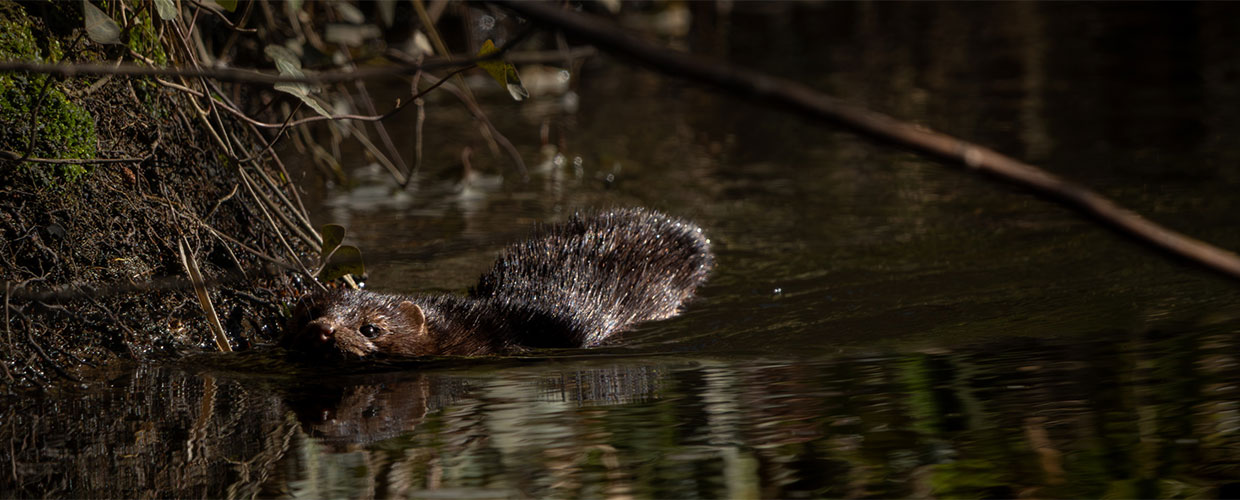
Humane mink trapping is at the heart of Waterlife Recovery Trust’s work to protect native wildlife from an invasive predator while upholding high welfare standards. This section explains how live‑capture traps, smart monitoring and careful field practice are used together to target mink as precisely and humanely as possible, minimise risks to other species, and support long‑term eradication rather than endless control. It brings together practical guidance on setting, checking and monitoring traps, humane dispatch, record keeping, safety and the use of new tools such as trap alarms and DNA analysis, so that everyone involved can contribute confidently to effective, responsible mink removal.
In this section there are Q&A’s, documents and checklists to help you choose the right equipment, set up smart rafts safely, and carry out humane mink trapping with confidence.
Mink trapping and dispatch often take place close to water and may involve air weapons, so every visit needs careful planning and a cautious approach. Waterlife Recovery Trust provides generic risk‑assessment guidance, but asks everyone involved to take responsibility for their own safety, avoid unnecessary risks and review hazards regularly before working in the field.
Other safety documents
Mink trapping and dispatch often take place close to water and may involve air weapons, so every visit needs careful planning and a cautious approach. Waterlife Recovery Trust provides generic risk‑assessment guidance, but asks everyone involved to take responsibility for their own safety, avoid unnecessary risks and review hazards regularly before working in the field.
Other safety documents
Mink dispatch work sometimes involves the use of air rifles, and the law treats these as firearms, with serious penalties for anyone who breaks the rules. Waterlife Recovery Trust therefore recommends that anyone using an airgun for humane dispatch is properly trained, fully aware of the legal requirements and follows the BASC Code of Practice for safe air rifle use.
View BASC code of practice >
The guidance explains key points of firearms law, including who may legally possess an air weapon, what counts as a public place, and how offences such as armed trespass can arise if people carry or use guns without permission on private land. It also sets out safe‑handling rules, from always knowing where the muzzle is pointing and assuming the gun is loaded, to ensuring a safe backstop, wearing eye protection at close range and stopping immediately if a misfire occurs.
Further sections cover transport, storage and maintenance, emphasising that airguns must be kept unloaded, out of sight and away from children when not in use, and should be regularly serviced by a competent gunsmith so they remain safe and reliable. The overall message is clear: humane dispatch is only acceptable when it is carried out within the law, with careful planning, respect for others and a strong commitment to safety at every stage.
View Firearms Legislation & Safety >
Checklist
Safe air rifle transport
-
Unload and un‑cock the rifle before moving it.
-
Remove any magazine and store pellets separately.
-
Carry the rifle in a zipped slip or case, out of sight.
-
In vehicles, keep the cased rifle flat, hidden and never leave it unattended.
-
Only travel with the rifle when you have permission and a clear lawful purpose.
Safe air rifle storage
-
Always store the rifle unloaded and un‑cocked.
-
Keep it in a locked cabinet, cupboard or case, out of sight.
-
Store pellets separately, ideally in a separate container.
-
Make sure children or unauthorised people cannot access the rifle or pellets.
-
Do not use the rifle if its condition is doubtful; have it checked by a competent gunsmith.